
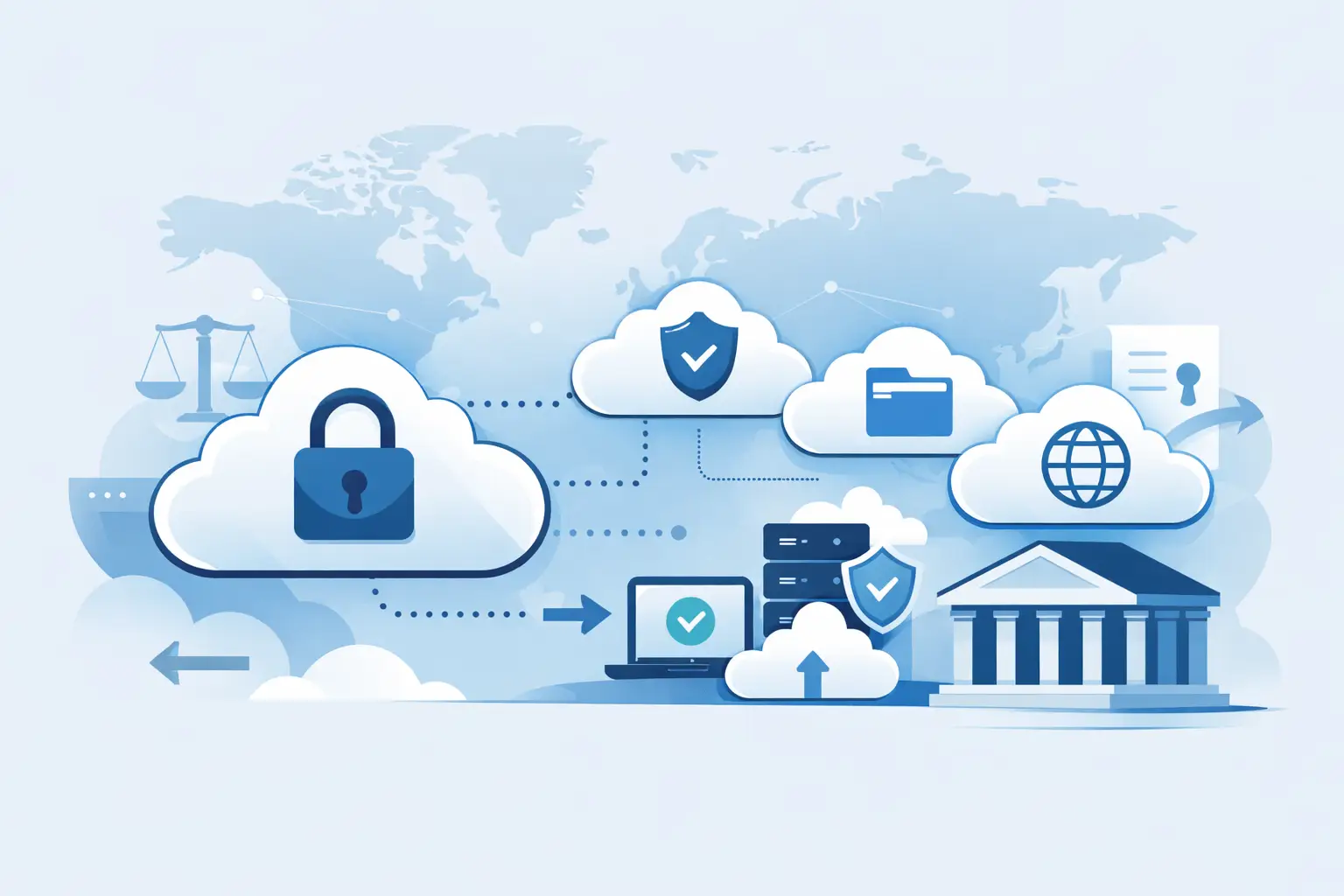
One board question changes the entire cloud conversation: who can compel access to your data, even when your servers sit in Europe? That is why searches for the best cloud act alternatives have moved from legal curiosity to procurement priority. For regulated organisations, critical infrastructure, public bodies and firms handling sensitive client information, this is no longer a theoretical risk. It is an operational, compliance and sovereignty issue.
What makes the best CLOUD Act alternatives credible?
A credible alternative is not just a non-American brand badge. If the provider is still exposed to US ownership, US control, or US legal reach through its corporate structure, the risk may remain. The best CLOUD Act alternatives reduce that exposure in substance, not in marketing.
That means looking beyond feature parity. File sharing, video calls and document editing are table stakes. The harder questions sit elsewhere. Where is the data stored? Who controls the encryption keys? Which legal jurisdiction applies? Can the provider prove operational independence from US hyperscalers? How quickly can you migrate without breaking permissions, metadata and business continuity?
For most enterprises, the right answer is not simply “move to another cloud”. It is to adopt a sovereign digital workspace that combines collaboration, storage, communication and security in one controlled environment. Fragmented tooling creates new attack surfaces and governance gaps. Replacing one dependency with five smaller ones is not a serious sovereignty strategy.
Best CLOUD Act alternatives for security-conscious organisations
1. Sovereign managed workspaces built on Nextcloud Enterprise
For organisations that want to leave the orbit of Microsoft 365 or Google Workspace without sacrificing usability, a sovereign managed workspace is often the strongest route. The model is straightforward: enterprise collaboration tools, hosted in a sovereign jurisdiction such as Switzerland or deployed on-premise, with managed security, migration and support wrapped around the platform.
This approach works because it tackles the full problem, not just storage. Teams still need documents, chat, video meetings, calendars, mobile access, permissions management and auditability. A well-run managed workspace gives you those essentials while keeping data control with the organisation. It is especially strong for public sector bodies, legal firms, healthcare providers and financial services teams that cannot afford ambiguity around jurisdiction.
The trade-off is that success depends heavily on the service partner. If migration quality, support maturity or enterprise hardening are weak, the project can stall. But when delivered properly, this is one of the few options that addresses sovereignty, productivity and resilience together.
2. On-premise private cloud collaboration
Some organisations should not compromise at all on location or control. In those cases, on-premise deployment remains one of the clearest CLOUD Act alternatives. Your infrastructure, your governance model, your network boundaries.
This is particularly compelling where data classification is high, legacy systems need tight integration, or policy demands direct control over infrastructure. It also offers a strong answer to ransomware resilience when paired with immutable backups, segmented access and disciplined identity controls.
The downside is obvious. On-premise environments require internal capability, funding discipline and operational maturity. If your team is stretched already, building and maintaining everything yourself can create a different kind of risk. Control without capacity is not sovereignty. It is technical debt with good intentions.
3. Swiss-hosted collaboration platforms
Switzerland remains attractive because it combines political neutrality, strong privacy traditions and a reputation for stable data governance. For European buyers that want a trusted non-EU but privacy-aligned hosting model, Swiss-hosted collaboration services often sit high on the shortlist.
The key word is “hosted”. A platform being available in Switzerland does not automatically make it sovereign. You still need to inspect ownership, subcontractors, support operations and infrastructure dependencies. If a Swiss instance ultimately rests on a US-controlled stack, the jurisdiction story weakens quickly.
Still, for organisations looking for practical deployment speed with a stronger sovereignty posture, Swiss hosting can be a serious step up from conventional hyperscaler arrangements.
4. Open-source collaboration stacks with enterprise support
Open-source platforms appeal to organisations that want transparency, flexibility and a visible route away from vendor lock-in. That appeal is justified. With the right architecture and enterprise support, open-source collaboration can provide document management, file sync, communication and workflow capabilities without handing strategic control to Big Tech.
For CISOs and IT leaders, the advantage is not ideological. It is structural. Open architectures reduce dependency concentration and make it easier to audit, adapt and govern the environment on your terms.
The caveat is that open-source is not automatically enterprise-ready out of the box. Security hardening, patch management, identity integration, monitoring and user adoption still need disciplined execution. Open source gives you control. It does not remove the burden of responsibility.
5. EU-owned cloud productivity suites
There is a growing market of European productivity vendors positioning themselves as privacy-first alternatives to Microsoft and Google. Some are focused on email and documents, others on secure communication or file services. For organisations with narrower needs, these vendors can be viable.
Where they tend to struggle is completeness. Many mid-sized and large organisations are not shopping for isolated apps. They need a workable replacement for a sprawling collaboration estate, often with compliance controls, archiving, mobile access and migration support built in. If the suite is too thin, shadow IT returns and your risk profile worsens.
This category is worth assessing, but only if you map it against your real operating model rather than a simplified procurement checklist.
6. Self-hosted secure file sharing plus separate communications tools
Some teams begin their move away from CLOUD Act exposure by replacing the most sensitive layer first: file storage. That can be sensible where document confidentiality is the immediate concern and broader collaboration replacement must happen in phases.
The benefit is lower disruption in the short term. The weakness is fragmentation. Once storage, chat, meetings, calendars and editing are spread across separate tools, governance becomes harder. Users create workarounds. Access models drift. Security teams inherit a larger integration burden.
This path can work as a transitional architecture, but it is rarely the end state for organisations aiming at long-term sovereignty and operational simplicity.
7. Air-gapped or high-assurance collaboration environments
For defence-adjacent operations, critical national infrastructure and highly sensitive public sector use cases, the answer may sit in high-assurance environments with limited connectivity, strict access control and tightly managed workflows. These are not mainstream productivity suites and they are not meant to be.
They offer the strongest isolation model, but usually at the cost of convenience, interoperability and user familiarity. For most commercial organisations, that trade-off is too extreme. For some, it is exactly the point.
8. Hybrid sovereignty models
A hybrid model combines sovereign collaboration for sensitive workloads with retained use of mainstream tooling for lower-risk functions. In reality, many enterprises will pass through this phase even if their long-term aim is fuller separation from US cloud dependencies.
The strength of hybrid is speed. You can ringfence high-risk data and regulated teams first. The weakness is policy complexity. Without clear classification rules and disciplined identity management, users blur the boundaries and risk follows them.
Hybrid is often politically easier inside large organisations. It is not simpler. It demands strong governance from day one.
9. Fully managed sovereign workspace platforms
The strongest option for many organisations is a fully managed sovereign workspace that consolidates storage, office productivity, chat, video, calendars and security controls into one environment. This model removes two common blockers at once: migration fear and operational overhead.
That matters because many firms stay with US cloud providers not out of confidence, but because exit looks painful. Permissions will break. Metadata will be lost. Users will revolt. Projects will overrun. A managed sovereign platform changes the equation when it can migrate the full Microsoft estate with fidelity, deploy quickly, and preserve business continuity while improving control.
That is where platforms such as Qsentinel stand apart. The proposition is not just privacy theatre. It is a practical route away from Big Tech, backed by sovereign hosting options, post-quantum encryption, ransomware protection, private AI and enterprise-grade migration support.
How to choose among the best cloud act alternatives
Start with jurisdiction, not features. If legal reach remains ambiguous, the rest of the evaluation is cosmetic. Then test operational reality. Can the provider support enterprise identity, logging, retention, mobile access, backup strategy and incident response? Can they migrate not only files, but rights, metadata and structure? Can they get you live in days or weeks rather than quarters?
After that, look at resilience. A credible alternative should reduce concentration risk, improve cyber hygiene and support compliance readiness for obligations such as NIS 2. Security and sovereignty should reinforce each other. If the platform gives you more legal comfort but weaker operational security, it is not an upgrade.
Finally, be honest about your internal capacity. Some organisations need maximum control and can run it themselves. Others need a managed model because speed, support and continuity matter more than infrastructure purity. There is no prize for choosing the most doctrinal architecture if your team cannot sustain it.
The market for CLOUD Act alternatives is maturing fast, but the winners will not be the loudest. They will be the providers that combine legal distance from foreign jurisdiction with enterprise usability, migration credibility and hard security. If your data is strategic, your workspace should be sovereign by design, not sovereign by brochure.