
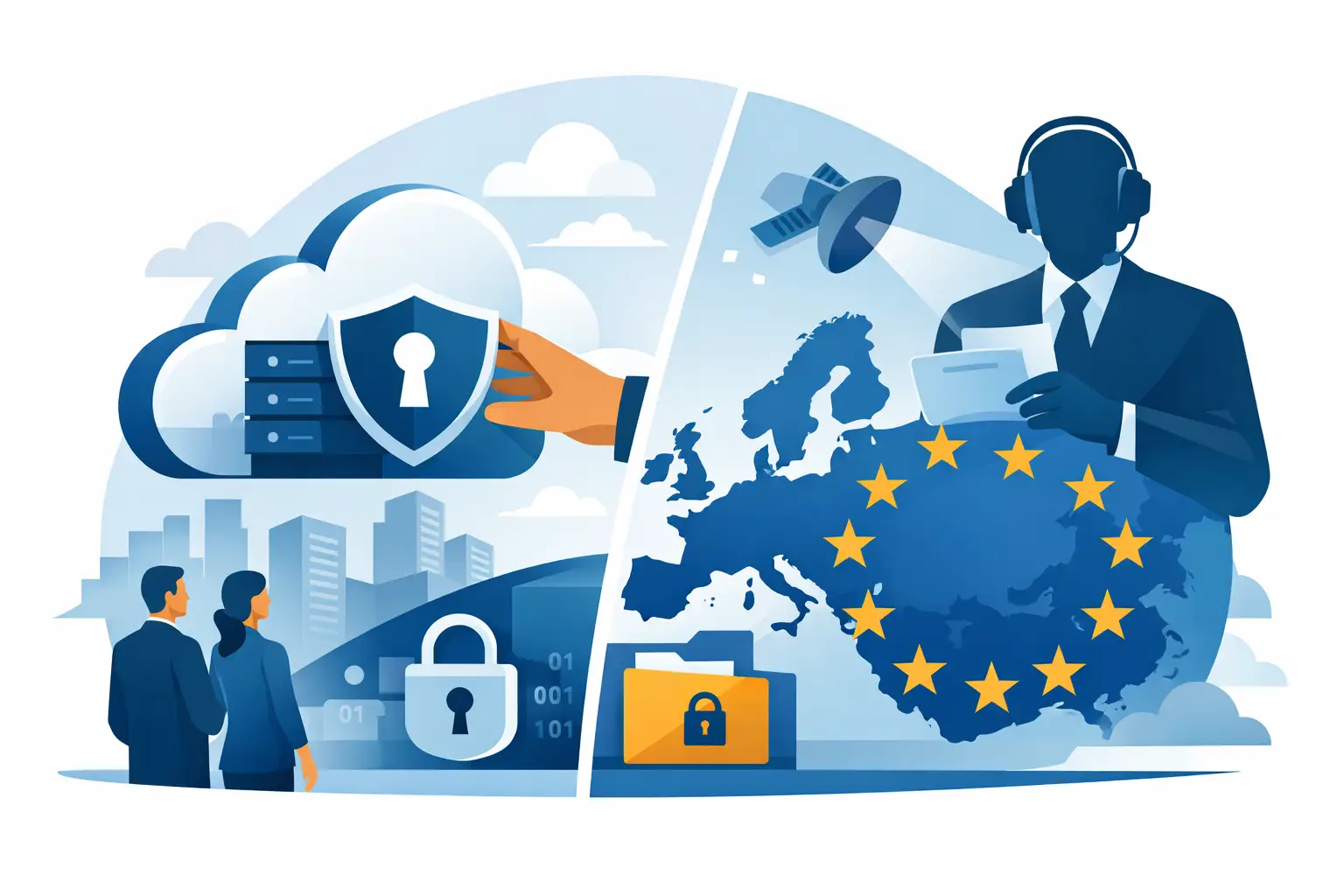
A contract says your data is stored in Europe. Your regulator is satisfied with the data residency statement. Your teams are collaborating happily in a familiar cloud suite. Then legal reality cuts across the architecture: if the provider is subject to US law, European storage does not automatically place that data beyond foreign reach. That is why the question ‘Does the CLOUD Act affect European companies’ is not theoretical. It is a board-level risk issue.
For security leaders, compliance officers and public-sector decision-makers, the CLOUD Act matters because it changes the real perimeter of control. Not the marketing perimeter. Not the diagram in a vendor slide deck. The legal perimeter. And if your organisation handles regulated, sensitive or strategically valuable information, that distinction is decisive.
Does the CLOUD Act affect European companies in practice?
Yes, and often more directly than many buyers assume.
The US CLOUD Act allows US authorities, under lawful process, to compel providers under US jurisdiction to produce data in their possession, custody or control, even when that data is stored outside the United States. For a European company using a US cloud provider, or a European subsidiary of a US provider, this creates a structural tension between data residency and data sovereignty.
That tension matters because many organisations still equate “hosted in the EU” with “protected from non-EU legal access”. Those are not the same thing. Data location is a technical and contractual choice. Jurisdiction is a legal exposure. If the provider can be compelled, the customer’s sovereignty is limited, regardless of the server postcode.
This does not mean every European company using a US platform is automatically non-compliant. It does mean the risk model is more complex than most procurement processes admit. The legal route to data access may exist even where the infrastructure remains physically in Europe.
What the CLOUD Act changes for European data control
The core issue is not simply whether data can be requested. It is who ultimately has the power to decide.
When a provider falls under foreign jurisdiction, the customer may no longer be the final authority over access pathways to its data. That weakens a central promise made by many mainstream cloud platforms: that customers are in control because they choose region, retention settings and permissions. Those controls are useful, but they do not override external legal compulsion.
For European organisations, especially those subject to GDPR, NIS2, sector-specific rules or national security expectations, this introduces a governance problem. If your operating model assumes that only European law governs disclosure, but your supplier stack says otherwise, there is a mismatch between compliance intent and operational reality.
This is where the conversation moves beyond privacy and into resilience. Sovereignty is not branding language. It is the ability to determine where data lives, who can access it, which law applies, and how those decisions are enforced in practice.
Why data residency is not the same as sovereignty
This is the point many vendors prefer to blur.
Data residency means your data is stored in a given geography. Data sovereignty means your data remains governed, accessible and controllable under the legal framework you intend, without hidden dependency on foreign authorities or provider control structures. You can have residency without sovereignty. In fact, that is common.
A European tenant inside a US-owned ecosystem may still rely on a legal and technical chain outside Europe. Support access, encryption key management, parent-company control, subcontractor structure and lawful access obligations all shape the actual risk. If one of those layers remains tied to foreign jurisdiction, the sovereignty claim becomes weaker.
For regulated organisations, that gap is not academic. A hospital, municipality, legal practice or financial services firm cannot treat legal exposure as a footnote. If confidential data, metadata or collaboration content can be reached through a provider subject to non-EU law, then the organisation must at least acknowledge that reality in its risk and compliance posture.
Does the CLOUD Act affect European companies under GDPR?
Potentially yes, and this is where it gets uncomfortable.
GDPR does not ban the use of US-linked providers outright. But it does require lawful processing, appropriate safeguards and accountability for international data access and transfers. If a provider can be compelled to disclose personal data, European organisations must assess whether their technical and organisational measures actually mitigate that exposure.
This is not just a legal drafting exercise. Regulators increasingly expect substance over paperwork. Standard contractual clauses, transfer impact assessments and provider assurances may still form part of the picture, but they do not eliminate the underlying jurisdictional conflict on their own.
The practical question is simple: if a foreign legal order can override your intended control model, are your protections real enough for the type of data you hold? The answer depends on the sensitivity of the data, the threat model, the sector, the architecture and the degree of provider dependence. But “our files are in Frankfurt” is not a serious answer.
Where the real business risk shows up
The immediate reaction to the CLOUD Act is often legal. The more strategic reaction should be operational.
Foreign jurisdiction risk affects procurement, incident response, customer trust, audit readiness and exit planning. It can also deepen vendor lock-in. Once collaboration, identity, documents, messaging and archives are concentrated inside a hyperscaler ecosystem, the legal and technical switching costs rise together. That makes every future sovereignty decision harder and more expensive.
There is also a reputational dimension. Clients, citizens, patients and partners increasingly ask where data is stored and who can access it. A vague answer no longer satisfies serious due diligence. If your organisation cannot explain the jurisdictional exposure of its collaboration platform in plain language, that weakness will surface sooner or later.
The sharpest organisations now treat this as part of cyber resilience. Not because the CLOUD Act is itself a cyber attack, but because dependency on opaque external control structures reduces strategic freedom during regulatory pressure, geopolitical friction and supplier incidents.
What European organisations should do next
The first step is to stop treating cloud risk as a pure infrastructure question. This is a governance and control question.
Map which providers in your collaboration and storage stack are subject to US jurisdiction, directly or through group structure. Then examine not just where data sits, but who can administer it, who holds the keys, which support channels can access it, and which legal regimes may compel disclosure. Many organisations discover that they have local hosting but not local control.
Next, separate convenience from necessity. Familiar user experience is not the same as strategic fit. If the platform that runs your documents, messaging, meetings and file sharing also creates unresolved jurisdictional exposure, then ease of use is only one side of the equation.
Finally, assess whether a sovereign alternative is viable at enterprise scale. For years, some buyers assumed sovereignty required sacrificing usability or slowing down deployment. That trade-off is now weaker than it used to be. Mature secure workspace platforms can deliver integrated collaboration, managed migration, compliance readiness and high-grade security without placing your data inside Big Tech’s legal orbit.
That is the practical shift the market is moving towards: not anti-cloud, but post-dependency. Cloud services still matter. Blind reliance on foreign hyperscalers does not have to.
The strategic answer to CLOUD Act exposure
If your organisation handles sensitive data, the strongest response is structural. Choose a platform model where legal jurisdiction, hosting control, encryption strategy and operational governance are aligned from the start.
That means favouring providers built around sovereignty rather than retrofitted marketing claims. It means asking whether private cloud, sovereign hosting in Switzerland or on-premise deployment better matches your regulatory and risk profile. It means ensuring migration is not treated as a painful one-off project but as a route out of lock-in. And it means viewing collaboration security as one discipline, not a pile of disconnected tools.
For organisations that want control without operational drag, this is precisely where specialist sovereign workspace providers such as Qsentinel stand apart. The value is not just where data is stored. It is that the whole operating model is designed to keep ownership, access and compliance under your control, away from Big Tech jurisdiction and without compromising enterprise usability.
The honest answer to ‘Does the CLOUD Act affect European companies’ is yes – but not every company is affected in the same way, and not every risk is equally material. What matters is whether your current platform leaves a gap between what your contracts promise and what your legal exposure actually permits. If there is a gap, the time to close it is before your regulator, your client or your next incident forces the issue.