
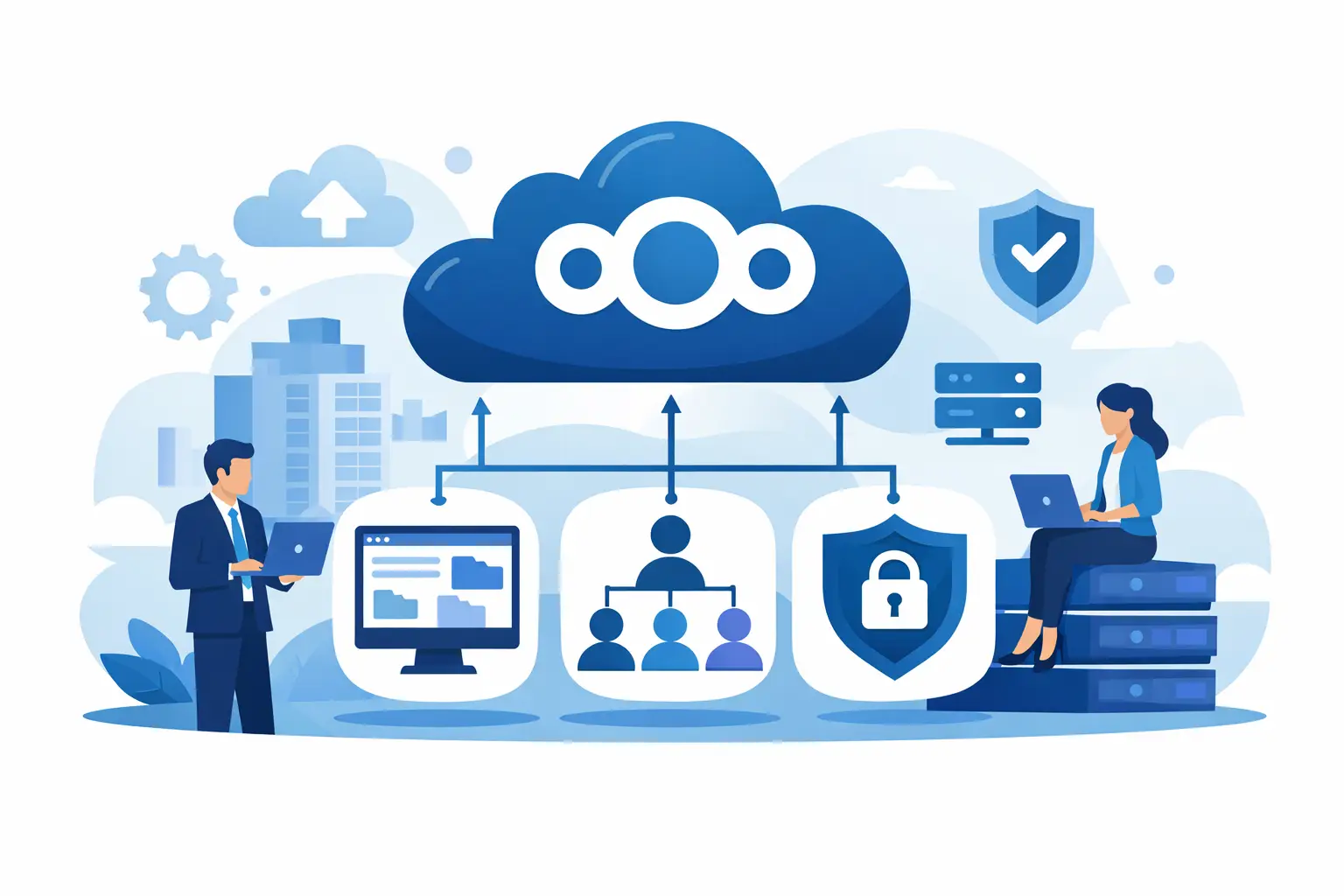
Most IT leaders do not set out to become experts in foreign jurisdiction risk. They get there because the board asks hard questions, regulators raise the bar, and another security incident exposes how much of the modern workplace sits inside someone else’s cloud. That is exactly where nextcloud enterprise as a service changes the conversation. It replaces dependency with control.
For organisations handling regulated, sensitive or strategically important data, collaboration is no longer just a productivity choice. It is an infrastructure decision with legal, operational and geopolitical consequences. If your files, chat, video meetings, calendars and identities run through US hyperscalers, you are not simply renting software. You are accepting exposure to external legal regimes, opaque data flows and a level of lock-in that becomes expensive to reverse.
What nextcloud enterprise as a service actually solves
At first glance, Nextcloud can look like a file-sharing platform with extras. That reading misses the point. In an enterprise setting, it is a sovereign digital workspace that brings storage, document collaboration, messaging, video, calendar and controlled data exchange into one managed environment.
The service model matters as much as the software. Running collaboration tooling internally is possible, but many organisations do not want another stack to engineer, patch, monitor and defend. Nextcloud enterprise as a service gives them the platform without the operational drag. That means faster deployment, managed updates, predictable support and a security posture that is enforced centrally rather than left to internal capacity constraints.
This is where the proposition becomes strategically relevant. You are not buying another app. You are moving core collaboration into an environment designed for sovereignty, compliance-readiness and cyber resilience.
The real issue is not features. It is control.
Microsoft 365 and Google Workspace are powerful, familiar and deeply embedded. That is why they are hard to displace. But feature breadth is not the only buying criterion any more. For many European organisations, the harder question is whether convenience is worth the legal and strategic trade-off.
Data sovereignty is often reduced to a slogan. In practice, it means knowing where data resides, who can access it, which jurisdiction can compel disclosure, and whether your provider’s commercial model depends on ecosystem lock-in. Those are not abstract concerns for public bodies, legal practices, healthcare organisations, financial firms or any business facing NIS-2 pressure. They shape risk exposure directly.
A managed Nextcloud environment shifts that balance. Data can be held in Switzerland or deployed on-premise. Administrative control is clearer. Integration can be deliberate rather than sprawling. Security controls can be designed around your organisation’s risk model instead of inherited from a general-purpose advertising or hyperscale ecosystem.
That does not mean every organisation must abandon mainstream suites tomorrow. It does mean the default assumption that hyperscaler dependency is inevitable is no longer defensible.
Why managed delivery beats self-hosting for most enterprises
There is a strong technical case for self-hosting, especially in highly specialised environments. If you have mature internal platform engineering, round-the-clock operations, tested recovery procedures and the appetite to own the full lifecycle, self-managed infrastructure can work.
Most organisations, however, want sovereignty without building another internal software company. That is the practical strength of nextcloud enterprise as a service. It combines the control benefits of a sovereign platform with the speed and accountability of a managed service.
That trade-off matters. Security patches do not wait for change windows to become convenient. Misconfigurations do not announce themselves politely. Ransomware recovery is not the moment to discover your collaboration estate has grown unevenly across departments. A managed service reduces those operational weak points while preserving strategic independence.
For leadership teams, this also simplifies ownership. Instead of juggling separate suppliers for storage, chat, document editing, video meetings, backup logic and migration consultancy, they can consolidate into one controlled workspace with a defined operating model.
Security has to be built into the workspace, not bolted on later
Many collaboration platforms rely on a patchwork of third-party add-ons and compensating controls. That creates blind spots. One tool handles files, another handles chat, another handles calls, and security teams are expected to stitch policy across all of them. The result is usually complexity, rising cost and weaker assurance than expected.
A properly delivered Nextcloud estate takes a different position. Security sits inside the workspace architecture. Access control, data handling, storage policy, encryption and recovery are not afterthoughts. They are part of the service design.
That is especially relevant in an era where ransomware is not just a device problem. It is a business continuity problem. If users cannot access documents, teams cannot communicate and audit trails are unclear, the operational impact spreads quickly. Collaboration tooling must therefore be treated as critical infrastructure.
This is also where advanced capabilities such as post-quantum encryption and private AI become meaningful rather than cosmetic. For organisations with long data retention periods or strict confidentiality requirements, future-proofing is not a luxury. It is prudent engineering. Private AI, meanwhile, offers productivity gains without sending sensitive business context into external model ecosystems.
Migration is where many alternatives fail
The biggest reason organisations stay with incumbent platforms is rarely love. It is fear of disruption. They assume migration means broken permissions, missing metadata, flattened folder structures, retraining chaos and months of parallel running.
That fear is justified when migration is treated as a bulk export exercise. Enterprise collaboration estates are full of hidden dependencies. Rights models are nuanced. Shared drives have history. Teams rely on structure that looks messy from the outside but remains operationally important.
A serious migration approach preserves fidelity. That means documents, permissions, metadata and folder logic move accurately, with governance intact. If that does not happen, the new platform inherits distrust on day one.
This is one area where a service-led model has a decisive advantage. The platform is only half the answer. Migration capability is the other half. Organisations need a route out of Microsoft dependency that does not punish them for years of accumulated complexity. Live in days, not months, is only credible if the migration engine is good enough to support it.
Nextcloud enterprise as a service and compliance pressure
Compliance teams are tired of buying point solutions to compensate for poor architectural choices. NIS-2, sector-specific regulation and rising customer due diligence all push in the same direction: prove control, prove resilience and prove accountability.
Nextcloud enterprise as a service supports that shift because it reduces sprawl. When documents, communication and sharing occur within a controlled environment, policy becomes easier to enforce and evidence easier to produce. That does not make compliance automatic. No platform can replace governance. But it gives governance a stable foundation.
It also helps organisations answer awkward board-level questions with more confidence. Where is the data? Which legal regime applies? How quickly can we recover? What is our exit path? Can we support remote teams without expanding attack surface? Those questions deserve precise answers, not supplier marketing.
For many European buyers, sovereignty is becoming part of fiduciary duty. If a viable alternative exists that reduces exposure to Big Tech and foreign jurisdiction, ignoring it is no longer a neutral decision.
Who should seriously consider this model
This approach is strongest for medium-sized and large organisations that handle sensitive information, face regulatory scrutiny or need tighter control over digital operations. Public sector bodies, legal firms, healthcare providers, financial services and security-conscious private enterprises fit naturally.
It is also a strong choice for businesses that are simply tired of fragmented tooling. If staff bounce between file platforms, meeting tools, consumer-grade messaging and separate document systems, the issue is not just user experience. It is governance drift.
That said, there are cases where a move may not be urgent. Smaller businesses with low regulatory pressure and minimal sensitivity in their data may decide mainstream suites remain adequate for now. Others may keep a hybrid estate for a period, especially where specialist integrations still depend on incumbent ecosystems. Sovereignty is not all-or-nothing on day one. But the direction of travel is clear.
Qsentinel’s approach is compelling because it turns that direction into an operational reality – sovereign storage, enterprise-grade security, full migration support and one managed workspace that stands outside the gravitational pull of Big Tech.
The most useful question is not whether your current suite still works. It is whether you are comfortable with who ultimately controls the ground beneath it. If the answer is no, the case for a sovereign workspace becomes very hard to ignore.