
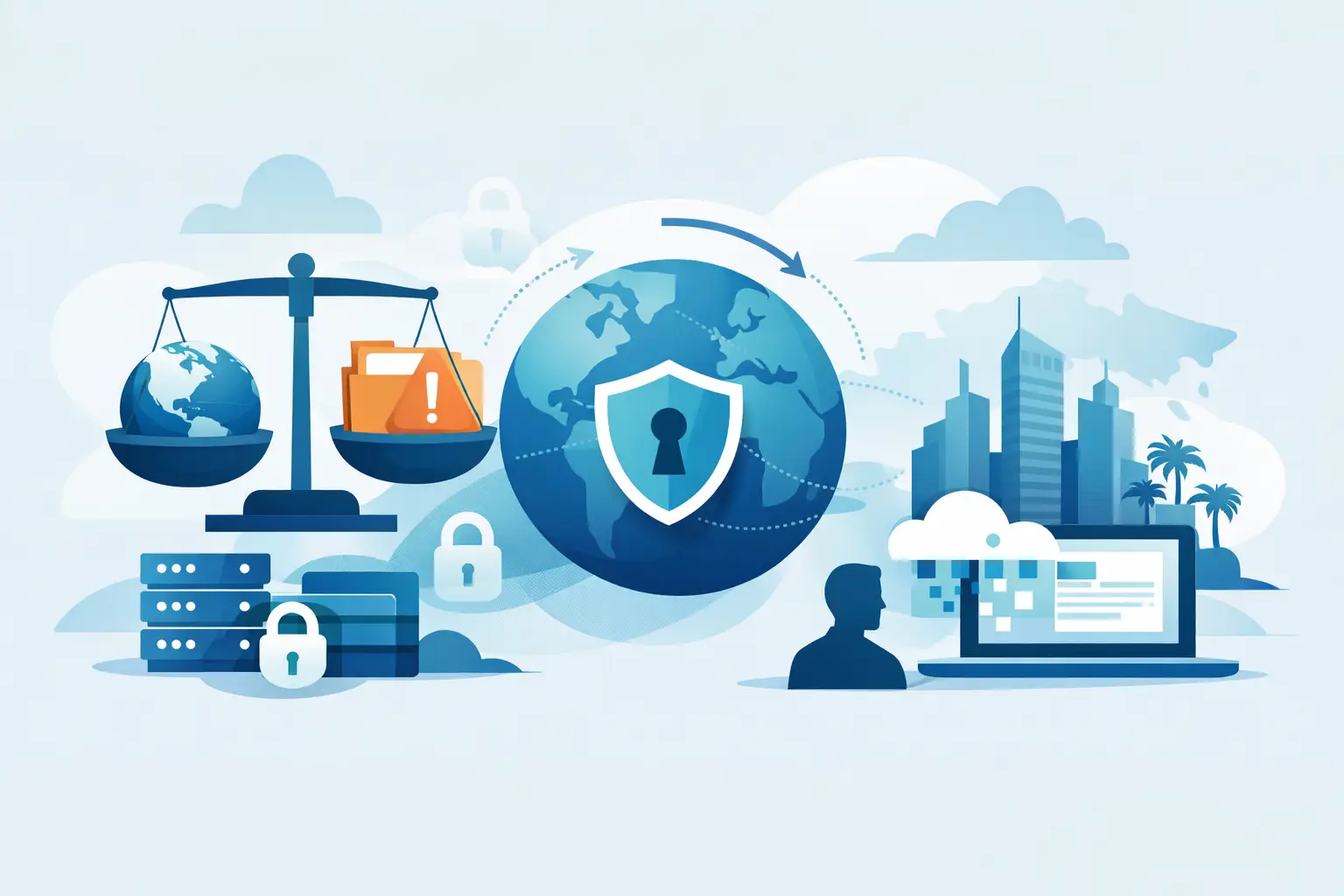
A procurement team signs off Microsoft 365. Legal approves the DPA. IT enables MFA and conditional access. Everyone feels covered – until a regulator, a client, or your own board asks a harder question: who can compel access to the data, and under which law?
That is where foreign jurisdiction data risks stop being a legal footnote and become a strategic security issue. If your files, chats, calendars, backups or metadata fall within the legal reach of another country, your exposure is not defined only by where the server sits. It is shaped by who controls the service, which parent company owns the provider, what laws apply to disclosure, and how little practical leverage your organisation may have when those powers are exercised.
What foreign jurisdiction data risks actually mean
Foreign jurisdiction data risks arise when your business data can be accessed, disclosed or processed under the laws of a country outside your own legal and regulatory environment. For many European organisations, the central problem is simple: a platform may present itself as local, even host data in Europe, while remaining subject to overseas legal demands because the provider is owned, operated or controlled elsewhere.
That distinction matters. Data residency is not the same as data sovereignty. Storing data in Frankfurt, Dublin or Amsterdam does not automatically place it beyond the reach of foreign authorities. If the provider is subject to extra-territorial laws, the legal attack surface extends far beyond the rack where the data sits.
For security leaders, this is not a theoretical concern. It sits at the intersection of governance, operational resilience, privacy, litigation exposure and national strategic autonomy. Once that data includes board papers, patient records, case files, source code, merger documents or internal security logs, the stakes rise sharply.
Why foreign jurisdiction data risks are growing
The market has normalised dependence on hyperscalers. Collaboration, storage, identity, backups and productivity tooling are increasingly bundled into a handful of ecosystems. That convenience comes with concentration risk, but also jurisdictional risk.
The problem has intensified for three reasons. First, more sensitive workflows now live in cloud collaboration tools rather than isolated internal systems. Second, regulation has become stricter, especially for operators of essential services, public bodies and organisations handling sensitive personal or commercial data. Third, foreign governments have expanded lawful access mechanisms, often with broad secrecy provisions that leave customers with limited visibility.
Many boards still assume cyber risk begins with hackers. In practice, legal compulsion can be just as consequential. If a foreign authority can lawfully require disclosure from your provider, your controls may be bypassed without any breach, malware or insider attack.
The main exposures organisations overlook
The first is compelled access. A foreign court order, intelligence request or law enforcement demand may require a provider to disclose customer data within its control or possession. Whether your organisation is notified, able to challenge it, or even aware of the scope depends on the law and the provider’s posture.
The second is metadata exposure. Even where content protections exist, metadata often remains highly revealing. Access patterns, communication graphs, timestamps, document activity and account relationships can expose business strategy, internal investigations and client relationships.
The third is compliance friction. UK and European organisations face obligations around lawful processing, minimisation, retention, auditability and sector-specific confidentiality. If your provider’s legal exposure clashes with those obligations, your compliance position becomes weaker, not stronger, no matter how polished the certification pack looks.
The fourth is concentration of control. If identity, email, documents, meetings and file storage are all bound into one foreign-controlled stack, a single jurisdictional dependency touches nearly every business process. That is not efficiency. It is systemic exposure dressed up as productivity.
Data residency is not enough
A common sales line is that data remains in Europe. That may help with latency and some regulatory requirements, but it does not settle the sovereignty question.
What matters is control. Who holds the administrative keys? Which entity contracts with you? Where is the support function located? Which legal person can be compelled? Can subcontractors access content or metadata? Are backups replicated elsewhere? Is telemetry exported outside your chosen region? These details decide whether your data is genuinely insulated or merely parked in a local data centre with foreign legal strings attached.
This is why organisations that are serious about sovereignty look beyond hosting geography. They assess ownership, chain of control, support access, key management and enforceable contractual boundaries. Without that, “EU hosted” can become a comforting label with very little defensive value.
How foreign jurisdiction data risks affect regulated sectors
For healthcare providers, the issue is patient confidentiality and continuity of care. For legal firms, it is privilege and case sensitivity. For financial services, it is market-sensitive information, supervisory expectations and third-party risk. For government and public bodies, it is democratic accountability and national resilience.
The risk profile differs, but the pattern is the same. Sensitive data handled under foreign legal exposure introduces uncertainty that is difficult to quantify and even harder to defend after the fact. Auditors, clients and regulators are increasingly asking more mature questions about cloud dependence. “Our provider is widely used” is not an answer. Neither is “the data is encrypted” if key control and administrative access remain elsewhere.
What a defensible response looks like
A credible response starts with classification. Not all data carries the same strategic weight. General marketing files do not require the same protections as M&A documents, HR records, litigation material or security operations data. But once critical workloads are identified, the hosting and collaboration model must match their sensitivity.
The next step is jurisdictional due diligence. That means mapping not just server location, but ownership, applicable law, subcontracting, support paths and access models. Many procurement exercises stop too early. They assess features and price, then treat legal exposure as boilerplate. That is precisely backwards for high-trust environments.
Encryption matters, but only if implemented with real control. Provider-managed encryption is better than nothing, yet it does not solve the underlying issue if the provider still has practical means to comply with compelled access. Stronger models combine sovereign hosting, tighter administrative boundaries, customer-controlled policies and architectures that minimise privileged provider access.
Operational design matters too. Consolidating collaboration, storage, communications and productivity into one secure environment can reduce sprawl and simplify governance – but only if that environment is not itself tied to an external jurisdictional choke point. Replacing five tools with one foreign-controlled suite may streamline IT. It does not reduce strategic dependency.
A more serious standard for modern collaboration
This is where the market needs more honesty. Security is not only about preventing unauthorised attackers from getting in. It is also about preventing authorised third parties from getting in through legal pathways you cannot meaningfully control.
For many European organisations, the stronger position is clear: keep sensitive collaboration and business-critical data in a sovereign environment, with hosting in Switzerland or on-premise where required, strict control over access paths, modern encryption, ransomware resilience and a migration path that does not wreck productivity. That is not ideology. It is sound risk engineering.
There are trade-offs, of course. Hyperscalers offer convenience, ecosystem breadth and familiar tooling. Some workloads may remain there for practical reasons. But convenience should not be mistaken for safety, and familiarity should not be mistaken for control. The mature approach is to decide deliberately which data can tolerate foreign legal exposure and which cannot.
That is why sovereign collaboration platforms are gaining traction among organisations that have moved beyond checkbox compliance. They want a digital workplace that supports real work – documents, chat, video, calendars, sharing, AI – without surrendering jurisdictional control in the process. Qsentinel sits squarely in that category, giving organisations a way to move away from Big Tech dependence without creating operational drag.
The board-level question you should ask now
Do not ask only where your data is stored. Ask who can reach it, under what authority, and whether your organisation has chosen that risk or simply inherited it.
Foreign jurisdiction data risks are not abstract, and they are not tomorrow’s problem. They are embedded in procurement choices being made right now across collaboration, storage and cloud productivity. The organisations that will hold their ground are the ones that treat sovereignty as an operational control, not a marketing claim.
If your data is business-critical, regulated or strategically sensitive, legal reach matters as much as cyber defence. Build your workspace accordingly.