
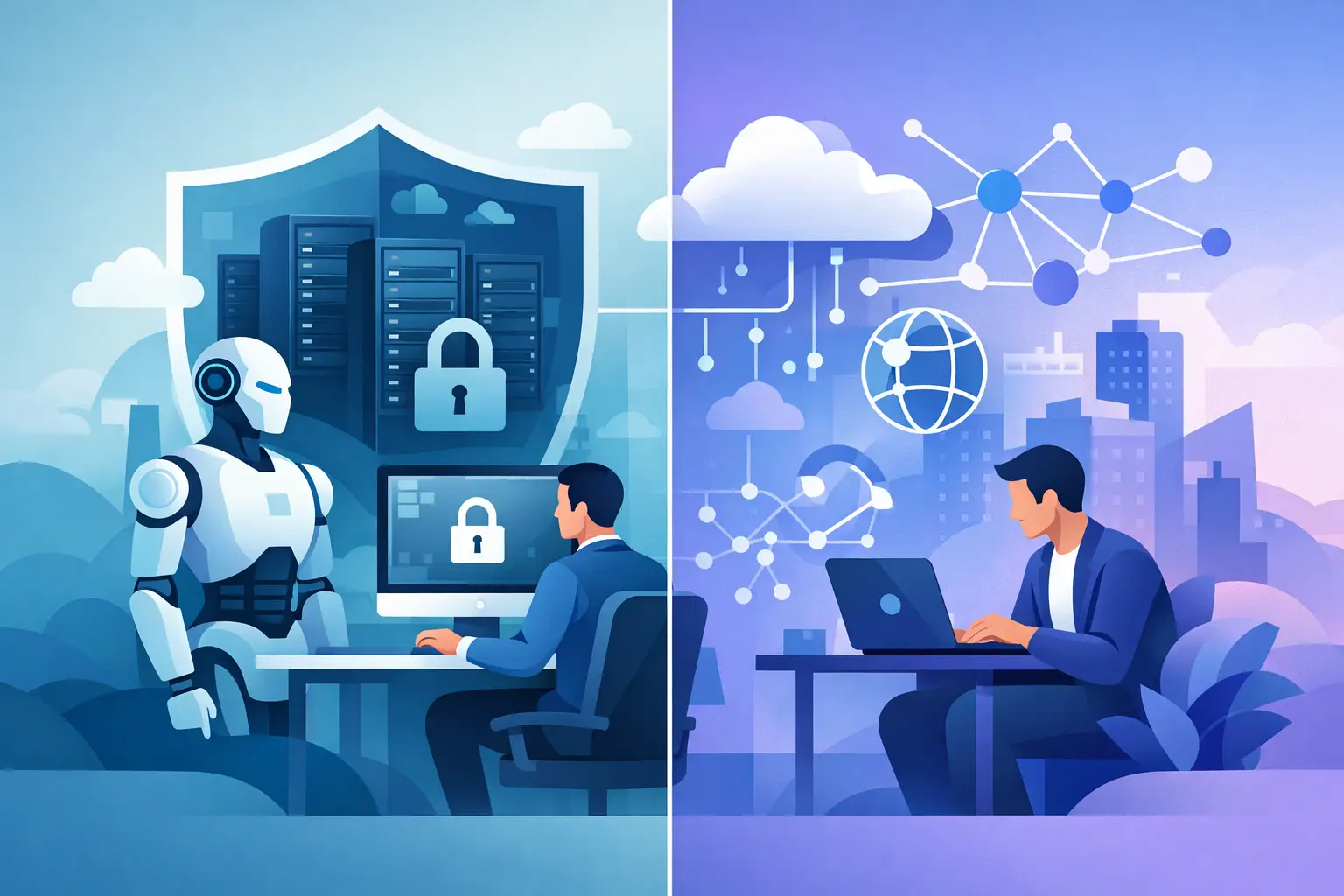
If your staff are pasting contracts, board papers or incident notes into a public chatbot, you do not have an AI strategy. You have a data exposure problem. That is why the debate around private ai vs public ai is no longer academic for European organisations. It is a board-level decision about control, jurisdiction, compliance and operational resilience.
Most organisations first meet AI through public tools. They are easy to access, quick to test and often impressive in demos. But convenience is not the same as suitability. Once AI starts touching regulated data, client records, internal know-how or security operations, the real question is not which model writes the slickest paragraph. It is who controls the system, where the data goes, and what risks you are quietly accepting.
Private AI vs public AI: the real distinction
The difference is not simply whether an AI tool sits behind a login page or runs on a separate server. The dividing line is governance.
Public AI typically runs on infrastructure controlled by a third-party provider, often a hyperscaler or a consumer-facing AI vendor. Prompts and outputs may pass through environments outside your control. Data handling terms can be complex, model behaviour can change without notice, and the provider ultimately defines the boundaries.
Private AI is built for controlled use inside a defined environment. Access is restricted, data flows are governed, retention can be managed, and deployment can sit in sovereign hosting or on-premise infrastructure. The organisation decides who may use it, what it may access and under which policies it operates.
That distinction matters because AI is not just another software feature. It processes language, meaning and context. In practice, that means staff will use it on the exact material you most need to protect: legal drafts, commercial plans, HR records, clinical notes, risk reports and internal communications.
Why public AI creates hidden exposure
Public AI is attractive because it removes friction. A user opens a browser, asks a question and gets a result in seconds. For low-risk use cases, that can be fine. Drafting a generic agenda or rephrasing a public press release is not the same as handling confidential material.
The problem begins when public AI becomes normalised across the business. Staff do not think in terms of data classification every time they copy and paste text. They think about speed. Under pressure, convenience wins. Sensitive material starts to move into systems the organisation does not fully control.
There are several layers of exposure here. The first is jurisdiction. If the provider operates under foreign legal regimes, your data may fall within the reach of laws and access frameworks outside Europe. The second is retention and processing. Even where vendors promise safeguards, many organisations still struggle to verify exactly what is stored, how long it is kept and what it may be used for. The third is governance drift. Public platforms evolve rapidly. Features, terms and default settings change. Your risk surface changes with them.
For CISOs and compliance teams, this is not theoretical. It creates uncertainty precisely where regulated organisations need certainty.
Where private AI earns its place
Private AI is not about rejecting innovation. It is about deploying AI on terms that match enterprise risk.
In a properly governed private AI environment, prompts stay within a controlled estate. Identity and access policies can be enforced. Logging can support auditability. Data residency can align with sovereign requirements. Integration with collaboration tools can happen without sending business-critical information into open consumer platforms.
This is especially relevant in sectors where confidentiality is not negotiable. A legal practice cannot treat client matter data as disposable. A healthcare provider cannot gamble with patient information. A financial institution cannot improvise around data lineage and access control. Public bodies face an equally hard constraint: they must protect citizen data while maintaining transparency, continuity and compliance.
Private AI also supports a more disciplined operating model. Instead of hundreds of unmanaged users experimenting across random tools, organisations can provide one approved environment with clear guardrails. That reduces shadow AI, strengthens policy enforcement and gives leadership a realistic view of how AI is being used.
Private AI vs public AI in compliance terms
For regulated organisations, the private ai vs public ai decision often comes down to evidence. Can you demonstrate control, not just claim it?
Public AI can be difficult to square with strict compliance obligations because too much depends on vendor assurances. You may receive documentation, contractual language and policy statements, but that is not the same as direct control over storage, processing paths and administrative access. When an auditor asks where the data went, who could access it and under which jurisdiction it was processed, vague confidence is useless.
Private AI gives organisations a stronger compliance position because the architecture itself is designed around restriction and traceability. Data can remain in sovereign hosting locations or on premises. Security controls can be aligned with existing policies. Administrative boundaries are clearer. For organisations preparing for NIS-2, or already operating under strict sectoral requirements, that difference is operationally significant.
Compliance, after all, is not a paperwork exercise. It is the ability to prove that your controls function under pressure.
The cost argument is more nuanced than it looks
Advocates of public AI often point to lower entry costs. On the surface, they are right. It is cheap to start, and that matters. But low entry cost is not the same as low total risk or low total cost.
If public AI leads to data leakage, policy breaches, fragmented usage, or expensive remediation work, the economics change quickly. Add legal review, procurement overhead, security exceptions, retraining and incident response, and the supposedly cheaper route starts to look fragile.
Private AI usually requires more deliberate implementation. That can mean more planning up front, tighter architecture choices and a stronger governance model. But for organisations handling sensitive information, that investment often buys stability. It reduces the chance that AI adoption becomes yet another uncontrolled layer in an already complex stack.
The sensible question is not, what is the cheapest AI we can access this quarter? It is, what is the safest way to scale AI without compromising sovereignty, continuity and trust?
Public AI still has a place
A mature view accepts that it depends on the use case. Not every AI task deserves a private environment.
Public AI can still be useful for low-risk, non-sensitive activities such as brainstorming public-facing copy, summarising published material or experimenting with general productivity workflows. The mistake is letting those acceptable use cases expand by default into areas involving confidential or regulated data.
That is why policy matters. Organisations need clear boundaries between permitted public use and protected private use. Without those boundaries, users will make their own choices. In most businesses, that means security loses to speed.
What decision-makers should ask before choosing
The fastest way to cut through AI marketing is to ask a few blunt questions. Where is data processed and stored? Under which jurisdiction does the provider operate? Can the environment be restricted to approved users and approved datasets? What logging, retention and access controls exist? Can the organisation enforce its own policies rather than relying on a vendor’s default posture?
If the answers are incomplete, evasive or heavily qualified, the risk is not under control.
This is where sovereign digital workspace providers have a clear advantage. AI should not sit apart from the rest of the estate as a loosely governed add-on. It should live inside the same controlled environment as documents, chat, files, calendars and collaboration flows. That is how organisations reduce fragmentation while keeping data protected from Big Tech exposure and foreign jurisdictional reach. Qsentinel’s position is simple: AI belongs inside a secure, sovereign workspace, not outside it.
The strategic choice behind private AI vs public AI
At first glance, this sounds like a tooling decision. It is not. It is a sovereignty decision.
Public AI asks your organisation to adapt itself to somebody else’s platform, policies and legal environment. Private AI lets you apply AI within your own operational boundaries. One model prioritises convenience first and control second. The other starts with control because the cost of getting it wrong is too high.
For organisations with sensitive data, critical operations and real compliance duties, that trade-off is not hard to read. AI can be transformative, but only when it is deployed in a way that protects the business rather than exposing it.
The smartest AI decision is often the least flashy one: keep your data where your control still holds.